Hostess Masterclass
The Junior League of Norfolk - Virginia Beach
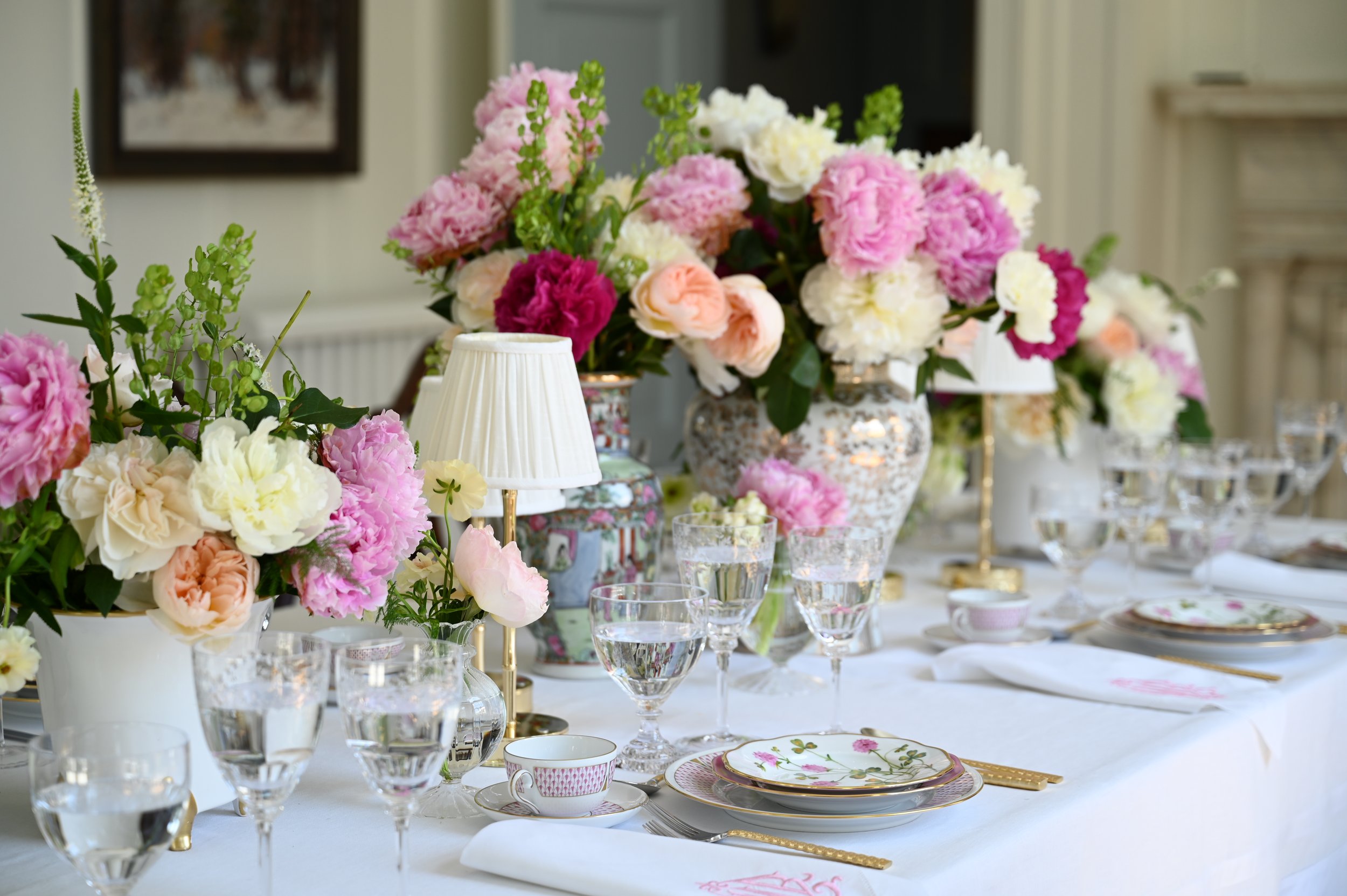
Thank you for spending a Sunday afternoon with me at the Truitt House. Here is all of it, written down, so you do not have to remember any of it. Print what helps and ignore the rest.
First, though, the question underneath all of it. What is the worst thing that can happen?
I have thought about that one for a long time, and I can give you the list. The rolls burn. Someone brings a guest you did not invite. The main event comes out plainly not done and eight people are already seated with their napkins in their laps. You run out of ice at nine. Somebody's husband says something about the election, and somebody else's husband answers him.
All of it has happened in this house. Some of it on the same night, and I would tell you which night, but I have worked very hard to put it behind me.
They never leave. They eat the rolls that are not burned. They fall in love with the extra guest, who turns out to be the most interesting person in the room. They drink their whiskey warm and are too well raised to mention it. And at eleven o'clock two of them are still in my kitchen with their shoes off while I am wondering how to get them out of my house.
That is the worst thing that can happen. Something goes sideways and the people stay anyway, and there you are, being loved in a kitchen full of dishes.
The rolls were never the fear. What stops us is being seen before we are finished. You let people in and they notice the chair you have not replaced and the dinner that did not work, and then they notice you. There is no version of this that takes that risk away. You invite them anyway. That is the part that counts, and it is the reason it feels like so much.
So remember this. Your house is ready. Not after the sofa comes, not when you have the right glasses, not once you have learned to cook something impressive. Now, whatever it looks like today, with whatever is in your cabinets.
You will get better at this, and everything below will help. But you do not have to be good at it to start, and no one has ever driven home from a dinner thinking about the plates or the baseboards.
You will also get more out of it than your guests do. They go home pleased and forget the menu by Wednesday. What you keep is better. You found out you are good at this before you felt ready to be.
And it was never only dinner. A table is where a neighbor turns into someone you would call. Everything that holds a town together got built one evening at a time, by women who set a place for somebody before the house was ready. You are one of them now.
Open the door.
With love,
Kristy
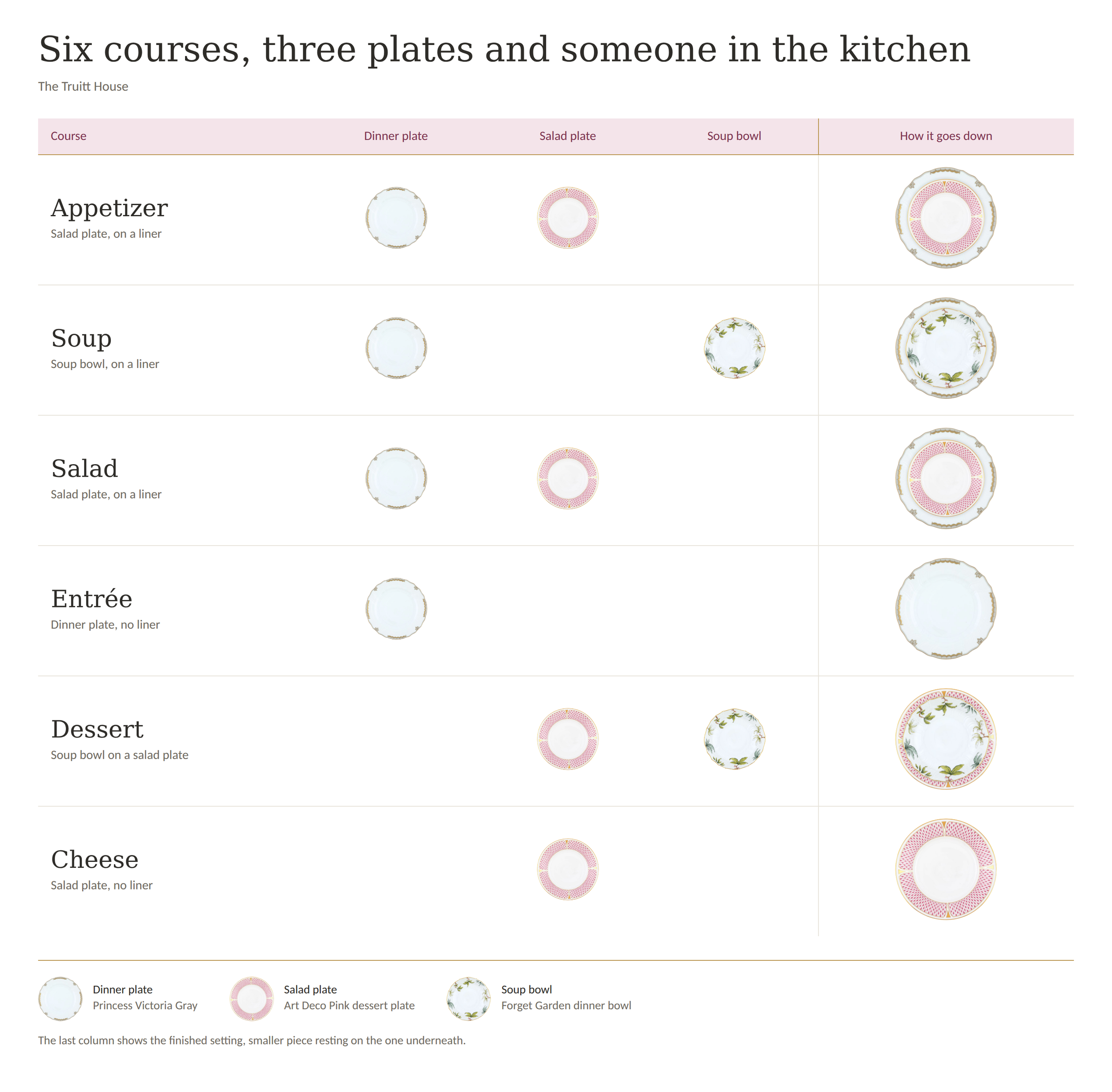
Three plates, six courses
One of you stayed after and asked how many plates it takes to put six courses on a table. I said three. I got a look back that I have gotten before, the one that says she thinks I am being polite and leaving something out.
I wasn't. Three plates will carry you through all six, and the reason it works is what goes underneath.
Always use an underplate
A place should never sit bare in front of a guest. When the appetizer plate comes off, something stays. That is the difference between a dinner that feels planned and one that feels like it is being assembled around your guests while they watch.
Your dinner plate is doing this work. It goes down at the start and holds the appetizer, then the soup, then the salad, and it is still there when the entrée arrives on it. One plate, four jobs, and your table never goes empty until you want it to.
The charger comes off before dessert
It has done its job by then. Clearing it lightens the table for the last two courses, and it signals something to the room without anybody announcing it. The evening is turning. Dessert and cheese sit closer to the cloth, the candles have burned down, people have their elbows on the table by now, and the setting should loosen along with everybody in it.
If you don't have chargers yet, use a tablecloth
You are building a collection. That happens over years, usually a few pieces at a time, sometimes because your mother handed them to you. In the meantime, a cloth does the same work a charger does. It keeps the table from reading as bare and gives every plate something to sit on. Linen if you have it, cotton if you don't, and it does not need to be white.
And then the part I actually believe
When I am serving something formal, traditional settings are my guideline, because they make sense. Somebody worked all of this out a long time ago in rooms full of people trying to feed each other well, and the rules are mostly just solutions to problems you would otherwise run into around nine o'clock with a bowl in your hand and no place to put it.
The rest of the time, anything goes as long as you love it. Mix the patterns. Use the dessert plate for salad. Put the gold with the blue. Your table, your people, your life.

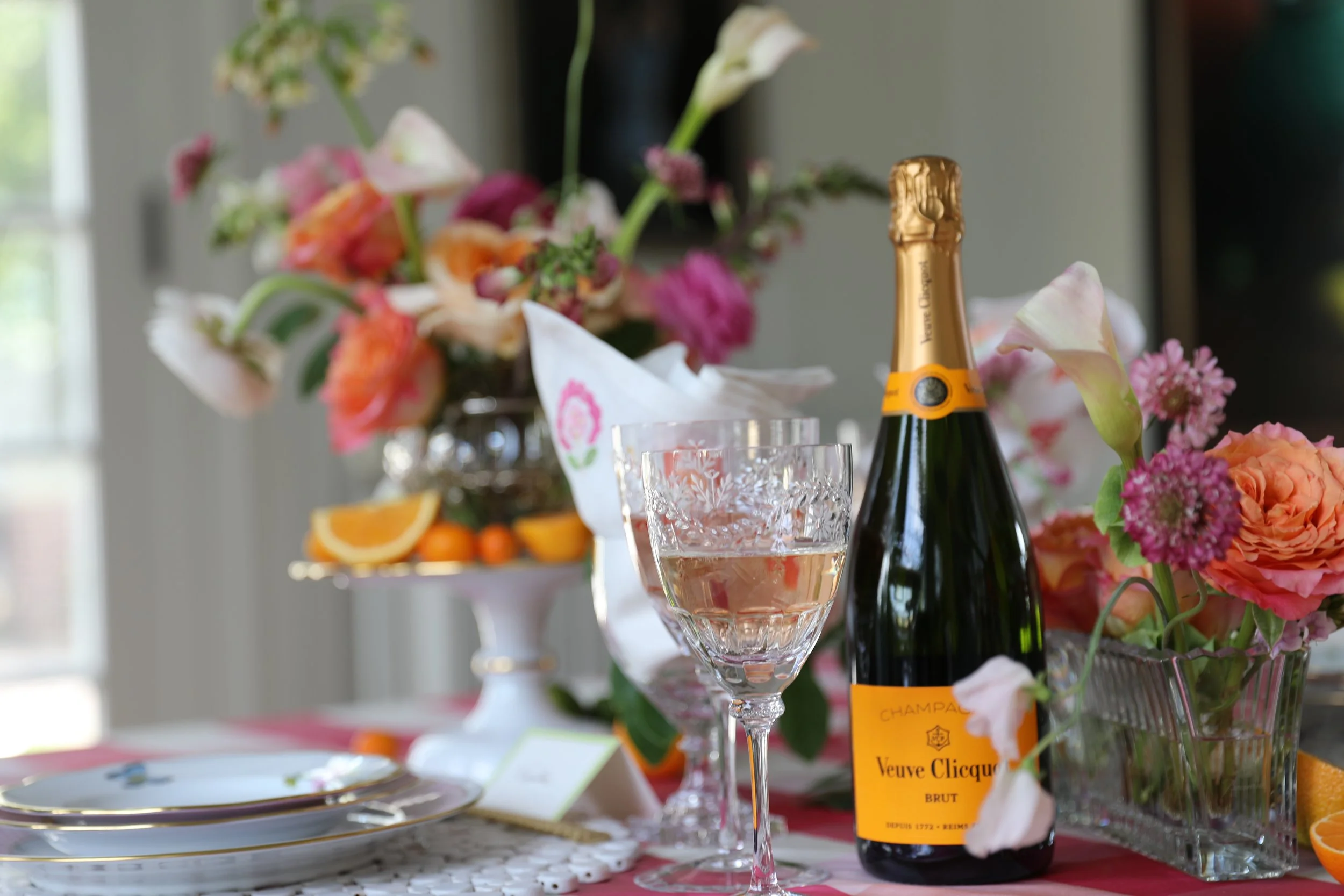
A drink in your hand
Nobody is themselves in the first four minutes. They have found parking, walked up to a door they have not walked up to before, and are holding something they brought you. The drink is what ends that part.
So have it ready. Not ready to make, ready to hand over.
Batch the cocktail in the morning and put it in something that belongs in the room, a pitcher or a decanter, so that pouring it takes four seconds and both your hands are free for the next person. A hostess who is measuring gin while her guests are standing in the hall is not hosting. She is bartending, and she has left the party she is throwing.
One drink. Not a list of options, not a question at the door about what someone would like. You hand a woman a glass and tell her what it is, and she is relieved, because now she does not have to decide anything either.
And there is always a mocktail, in a glass exactly as beautiful as the other one.
I mean the same glass, the same garnish, the same care. A woman who is not drinking, and there is one in every room, should not have to explain herself at the door or hold something that announces her business to everybody standing near her. Whatever the reason, it is hers. Hand her a coupe with a twist in it and say nothing. She will notice, and she will remember it long after everyone else has forgotten what was for dinner.
Notes on glassware:
Glasses do not have to match.
Mix different patterns on your table for each course of wine.
For larger parties, collect the basics. A stemless wine can be used for white or red. A coupe is for a cocktail, champaign, and dessert. Rocks glasses are important. Use them for appetizers (literally, with food) and for any kind of drink.
The bar
People ask me where the bar goes, and they are usually asking about the room. They mean, is there space, is the counter big enough, is the sideboard the right height.
That is not the question. Put the bar wherever you want the people to be.
The bar is not storage. It is the most reliable tool you have for moving fifteen people around a house. Wherever it sits is where they will stand, and they will stand there all night whether you meant it or not. So decide first where you want the party to happen, and then put the drinks there.
Which means away from the kitchen, always. If the bar is in the kitchen, the party is in the kitchen, and you are cooking in the middle of it. And away from the food, so the people waiting for a drink are not standing between everyone else and the table.
If you want the party to move, move the bar. Cocktails in the living room, champagne in the dining room after dinner, coffee somewhere else entirely. You do not have to announce any of it. People follow the glass.
How to make it work for you
You pour the first drink. After that it is self-service and you say so plainly, one time. A guest who has been shown where the ice is will take care of herself, and then take care of the person behind her.
How much wine to buy
Half a bottle per person per two hours. For eight people over an evening, six bottles, and buy eight. Wine you do not open keeps. A party that runs dry does not recover.
Champagne pours six flutes to the bottle. Always more than you think, and there is no such thing as an awkward leftover bottle of champagne.
Spend on: an ice bucket you like looking at, good glassware in one shape that does everything, a corkscrew that works.
Skip: a glass for every kind of drink, specialty mixers, anything that does one job.
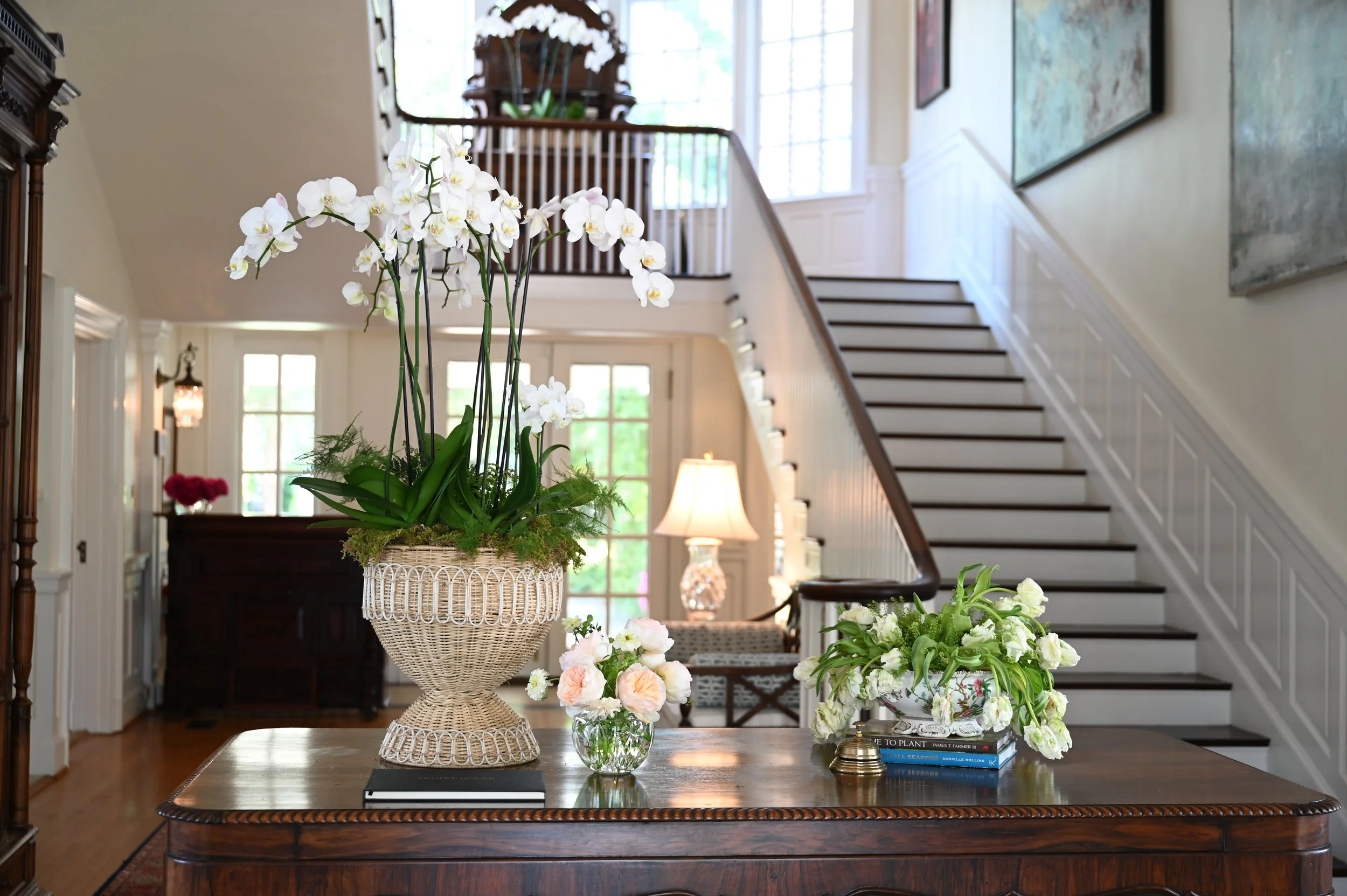
The first impression
A guest decides how she feels about your house in the time it takes to get from the car to a chair. Almost none of that is the furniture.
On furniture
Your house does not have to be new. It has to be tended.
A room full of pieces you chose and have kept up reads as gracious at any age, and a room full of new things nobody has decided anything about reads as a showroom. What a guest picks up is not that your house is current. It is that somebody cares for it. That is available to you today, in the house you are standing in, at no cost.
So: everything level, everything clean, one surface cleared. A cleared surface is the signal. It tells a woman walking in that room was made for her.
On light
Light is the biggest change you can make in a house for the least money, and almost no one makes it.
Overhead lights off. All of them. Overhead light flattens faces and makes a room look like an office at four in the afternoon.
Lamps around the edges of the room, on dimmers, at eye level when you are sitting down.
Candles lit before the first guest arrives. A candle lit in front of people is a chore. A candle already burning is a welcome.
Daytime, open everything and let the windows do it. Evening, close the curtains and let the lamps pull the room in close.
If you do one thing on this page, do the lamps. It costs less than the wine and it changes every face in the room.
On scent
A realtor will tell you to keep a house neutral, and she is right for selling and wrong for hosting. She wants a box a stranger can picture owning. You want a house that smells like somebody lives here and was expecting you.
Nothing too sweet, nothing edible, nothing out of a plug. Cinnamon roll and pumpkin are apologies. They say the house had a smell and we covered it up.
I use a room spray and candle scents in peony for spring and summer; red currant, fall and winter.
The free one: open the windows for twenty minutes before anyone arrives, in any weather, then close them.
The powder room
The only room in your house every guest visits alone, with the door shut and nothing to do but look around. It is where she forms her real opinion, and it is the cheapest room to get right.
Here are some gudelines: A lamp instead of the overhead. Real hand towels are luxurious, and enough of them that the fourth person does not get a damp one. Soap you would use yourself. Something living, one stem is plenty. A candle. Nothing personal in view.
I buy Caspari printed hand towels by the case right after Christmas. It’s an easy way to have a pretty look on hand without getting the iron involved.

Resources
Things I use to host at The Truitt House
Recipes to Know by Heart
Websites to Shop
The Hostess Dresses